



PMDC Motors
Comments Off on PMDC Motors
PMDC motors are commonly selected for equipment that requires consistent speed, high starting torque, and straightforward control. They are used in industrial automation, medical equipment, packaging systems, material handling, office equipment, and many OEM products. For manufacturers, choosing the right motor can improve equipment performance while helping reduce maintenance requirements and installation space.
What Is a PMDC Motor?
A PMDC motor converts electrical energy into mechanical motion through the interaction between permanent magnets and the armature. Since permanent magnets create the magnetic field, the motor does not require separate field windings. This reduces overall size while maintaining dependable output.
Current passes through the armature windings, creating a magnetic force that interacts with the permanent magnets. The result is continuous shaft rotation that powers a wide range of machines and equipment.
Common characteristics of a PMDC motor include:
- Compact construction for installations with limited space
- High starting torque for demanding applications
- Simple speed adjustment by changing the input voltage
- Efficient operation with fewer electrical losses
For many OEM applications, a permanent magnet motor provides an excellent balance between performance, size, and operating efficiency.
Key Advantages of PMDC Motors
PMDC motors continue to be a practical choice because they offer dependable performance without unnecessary complexity. Their compact construction also makes it easier to integrate into equipment where installation space is limited.
Some of the key advantages include:
- Energy-efficient operation
- Compact and lightweight construction
- High starting torque
- Simple voltage-based speed control
- Long service life with proper maintenance
- Easy compatibility with gearboxes and encoders
- Quiet operation for many commercial and industrial applications
- Reliable performance across different operating conditions
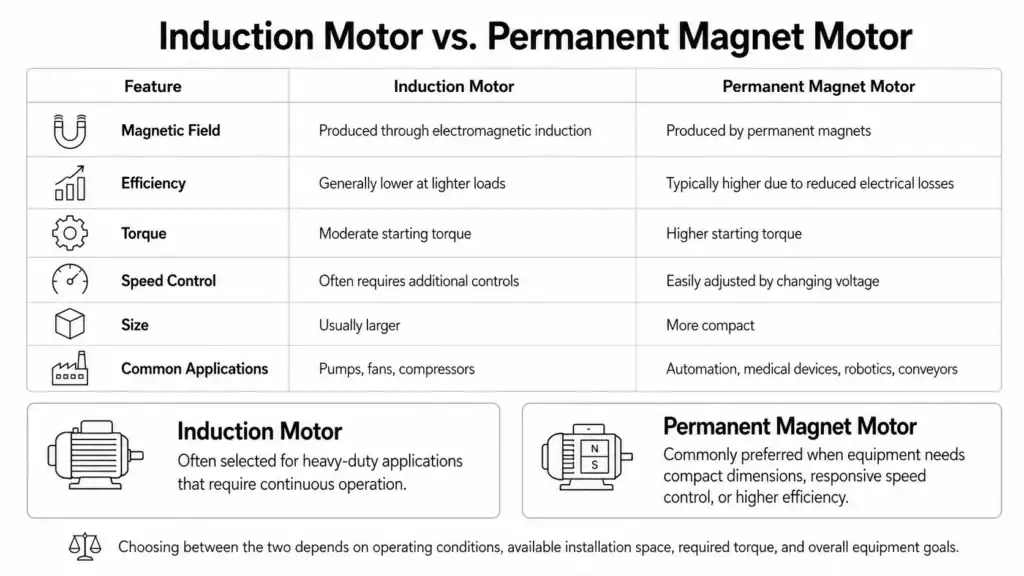
Induction Motor vs Permanent Magnet Motor: What’s the Difference?
The comparison between an induction motor vs permanent magnet motor often depends on the application’s performance requirements. Both motor types serve important roles, but each has strengths that fit different operating conditions.
| Feature | Induction Motor | Permanent Magnet Motor |
| Magnetic Field | Produced through electromagnetic induction | Produced by permanent magnets |
| Efficiency | Generally lower at lighter loads | Typically higher due to reduced electrical losses |
| Torque | Moderate starting torque | Higher starting torque |
| Speed Control | Often requires additional controls | Easily adjusted by changing voltage |
| Size | Usually larger | More compact |
| Common Applications | Pumps, fans, compressors | Automation, medical devices, robotics, conveyors |
An induction motor is often selected for heavy-duty applications that require continuous operation. A permanent magnet motor is commonly preferred when equipment needs compact dimensions, responsive speed control, or higher efficiency.
Choosing between the two depends on operating conditions, available installation space, required torque, and overall equipment goals. Working with an experienced motor supplier can help simplify the decision while identifying options that fit your design.
Common Applications for PMDC Motors
PMDC motors support many industries because they provide dependable motion in compact equipment. Their flexibility allows them to be integrated into systems that require steady performance and accurate control.
Some common applications include industrial automation equipment, conveyor systems, packaging machinery, medical devices, laboratory equipment, robotics, office automation systems, material handling equipment, automotive manufacturing equipment, and precision positioning systems.
Manufacturers often pair PMDC motors with gearboxes or feedback devices to meet application-specific performance requirements. Elinco International JPC, Inc. offers configurable solutions that support a wide variety of industries, making it easier for OEMs to source motors that fit their equipment without unnecessary modifications.
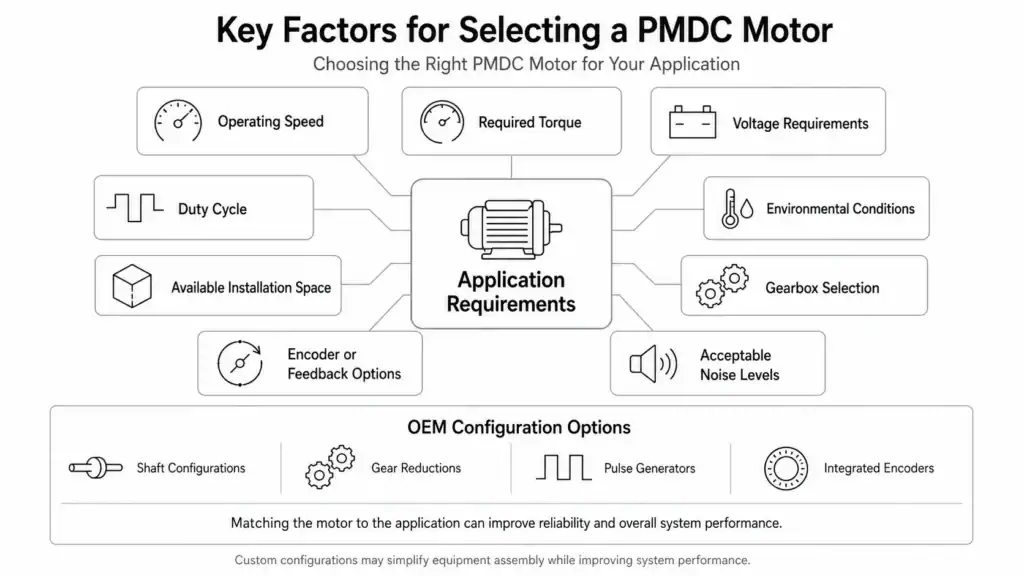
Choosing the Right PMDC Motor for Your Application
Selecting the right PMDC motor starts with understanding how the equipment will operate. Every application has different performance requirements, and matching the motor to those needs can improve reliability and overall system performance.
Important factors to evaluate include required torque, operating speed, voltage requirements, duty cycle, available installation space, environmental conditions, gearbox selection, encoder or feedback options, and acceptable noise levels.
For OEM manufacturers, customization can also be an important consideration. Features such as different shaft configurations, gear reductions, pulse generators, or integrated encoders may simplify equipment assembly while improving system performance.
Keep Your Equipment Moving With the Right Motor
The right PMDC motor can make a difference in efficiency, reliability, and long-term performance. Whether you’re developing new equipment or upgrading an existing system, Elinco International JPC, Inc. offers PMDC motor solutions and engineering support to help you find the right fit. Contact our team today to discuss your application and get started with a motor solution built for your operational needs.
FAQ
Can PMDC motors be customized for OEM applications?
Yes. Many PMDC motors can be configured with different gearboxes, shaft designs, encoders, pulse generators, and other features to meet specific equipment requirements. Custom configurations can help simplify integration into new or existing systems.
What factors affect the lifespan of a PMDC motor?
Motor lifespan depends on factors such as operating load, duty cycle, maintenance practices, environmental conditions, and proper motor sizing. Selecting a motor that matches the application’s requirements can help extend its service life.
Can a PMDC motor be paired with a gearbox?
Yes. PMDC motors are commonly combined with gearboxes to increase torque, reduce output speed, or achieve more precise motion control. The appropriate gearbox depends on the application’s performance requirements.
